Performance marketing · MarTech · AI automation

Performance marketing, and the systems behind it

10+ years of hands-on performance marketing across 15+ markets, and the internal systems behind it: campaign launch automation, spend and conversion data, reporting, and AI agents that propose changes while people decide.

Ticino, Switzerland · Swiss Permit S · English (B2, professional working), Russian (native), Ukrainian (fluent), Italian (basic)

Demo data. The approval cycle of the platform below, replayed with synthetic numbers.

3 peopleperformance team using it daily
100+ad accounts, with 100+ campaign launches a month
~20 → ~5 minper campaign launch

Selected work

Systems I built and run

01 · Flagship

Marketing operations platform

An internal platform for a performance marketing team: campaign launch automation, hourly spend sync, server-side conversion tracking, a self-hosted attribution layer, a Telegram control bot and an AI analyst whose proposals a person approves.

  • Node.js
  • Next.js
  • PostgreSQL
  • Python
  • Meta Marketing API
  • Conversions API
  • Telegram
  • Hermes Agent

Read the case study →

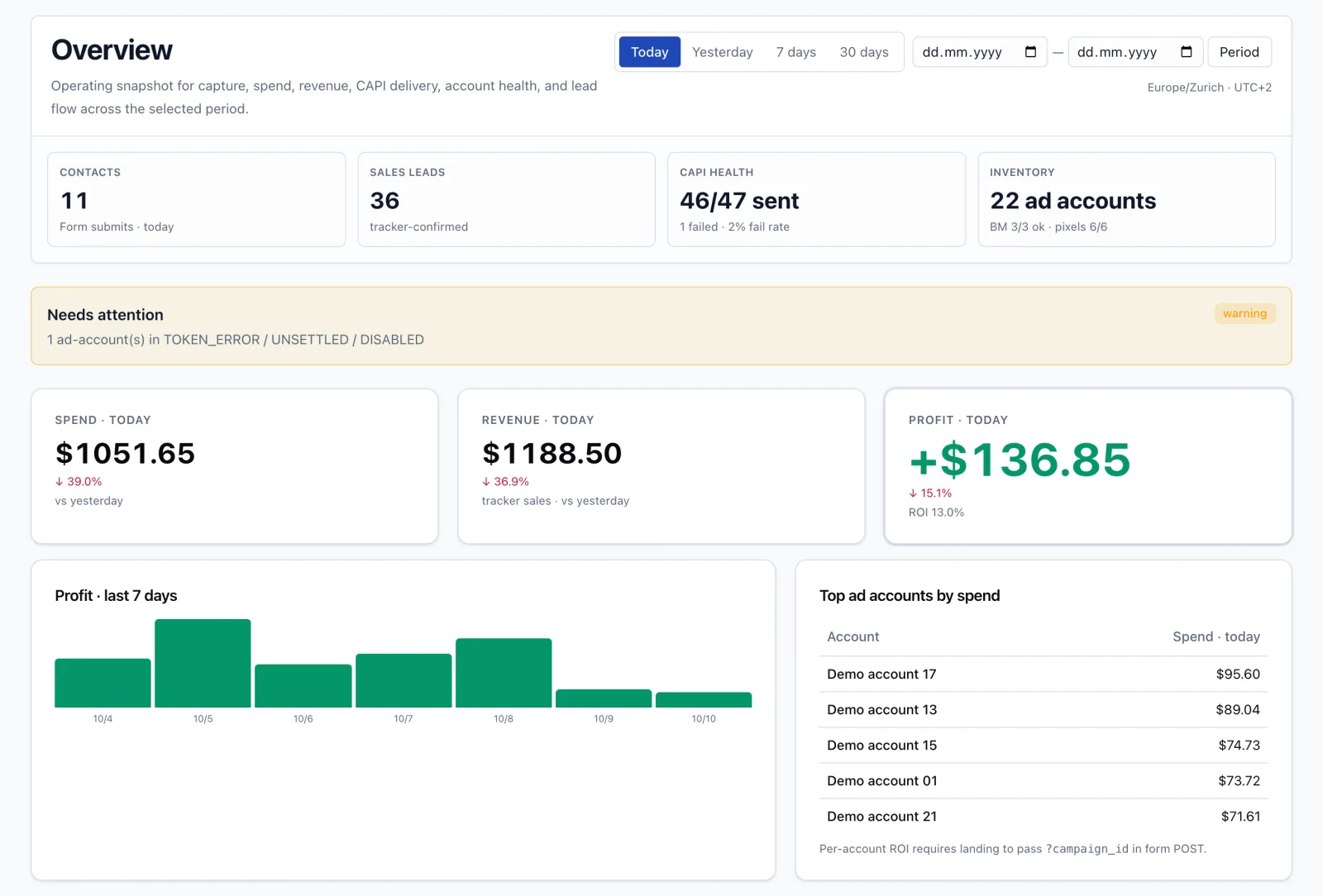
Platform overview dashboard with contact, sales, Conversions API and inventory tiles, spend, revenue and profit for today, a seven-day profit chart and top ad accounts by spend
Demo data. Overview dashboard of the platform.

02 · Content production

AI content production

A script engine and a documentary video studio for long-form YouTube films. The pipeline's first generation produced the videos of my channels: 4.7M+ views, 1.13M+ watch hours, 27.6k+ subscribers. A person approves the references before bulk frame generation.

  • Python
  • FastAPI
  • PostgreSQL
  • React
  • LLM pipelines
  • YouTube Data API

03 · Landing pages

Landing page builder

A block constructor for landing pages with AI-written copy that is validated before use, interactive game blocks and themed design sets. Automated quality checks run on every block.

  • React
  • Node.js
  • Express
  • Prisma
  • PostgreSQL
  • Playwright

How I work with AI agents

Agents write most of the code. The decisions and the quality bar stay with me.

I build with AI coding agents (Claude Code, OpenAI Codex). I write the specification, define the tests that gate every release, review the result and run it in production.

Illustration. The 608-test gate is from the tracker repository.

  1. Specification first. Every change starts as a written spec and plan. Detailed instruction files (AGENTS.md) define how the agents work in each repository.
  2. Tests as a release gate. The tracker build refuses to produce a release without passing results for that exact code: 608 tests.
  3. Dry-run and shadow mode before live. New paths run as dry-runs or in shadow next to the old ones before they touch ad accounts or money.
  4. People approve actions. AI agents read and propose. Changes to campaigns and budgets need a person's "Yes" and stay within hard limits.
608 testsin the tracker's release gate
20 releasestagged, each with written evidence
Restore drillsbackups are tested by restoring them

Background

10+ years in digital and performance marketing

Advertising

Hands-on campaign work across 15+ markets. Meta Ads as the main platform, plus Google Ads and TikTok Ads.

Tracking and data

Meta Conversions API, Meta Pixel, server-side tracking, event deduplication, S2S postbacks, GA4 and GTM.

Content operations

YouTube channel operations and long-form content production, which my content automation projects grew out of.

Education: Bachelor’s degree in Business, Management and Marketing · Luhansk Taras Shevchenko National University, Ukraine · 2006–2010

Open to

Positions I'm open to

On-site in Ticino; hybrid in Zurich, Zug or Lucerne; remote.

Contact

Let’s talk